Facts of the Day
Next Generation Incubation Services
- Next Generation Incubation Services (NGIS) initiative has been brought by the Software Technology Parks of India (STPI).
- The aim is to develop and build an ecosystem for startups in tier-2 locations in partnership with the Ministry of Electronics and IT.
- NGIS program is created and aligned with the vision of National Policy on Software Products (NPSP 2019) and it will create a robust ecosystem for software product development in the country.
- It will be implemented in 12 STPI centers across the country over a period of 3 years.
- The local startup ecosystem will be nurtured and supported.
- As part of NGIS, quarterly challenge programmes will be conducted in association with industry partners and central government departments that can provide mentorship as well as funding support.
- MeitY has approved Rs 60 crore to be spent in three years for the 12 locations to nurture about 300 start-ups and all the state governments too have been extending matching grants.
- STPI also announced the launch of ‘CHUNAUTI’ - Challenge Hunt under NGIS for Advanced Uninhibited Technology Intervention.
Indian Depository Receipt
- India Depository Receipt is an instrument in the form of a depository receipt (DR) created by the underlying equity shares of the issuing company.
- In an IDR, foreign companies would issue shares to an Indian Depository and thus can mobilize funds from India by selling shares.
- IDR is an opposite case of Global depositary receipt (GDR) or American depositary receipt (ADR).
- Standard charter recently delisted its IDRs from domestic exchange.
- Standard Chartered Bank decided to delist, as the issue failed to convince both the bank and investors.
- The IDRs had made a debut on the Indian bourses exactly 10 years back on June 11, 2010.
- Domestic bourses were not able to attract any other company to raise funds from India through the IDR route. Reasons behind lack of interest in IDRs are
- Initial entry barrier,
- Lack of fungibility awareness,
- Tax issues
- Failure to popularize the product across the globe.
Methane Budget
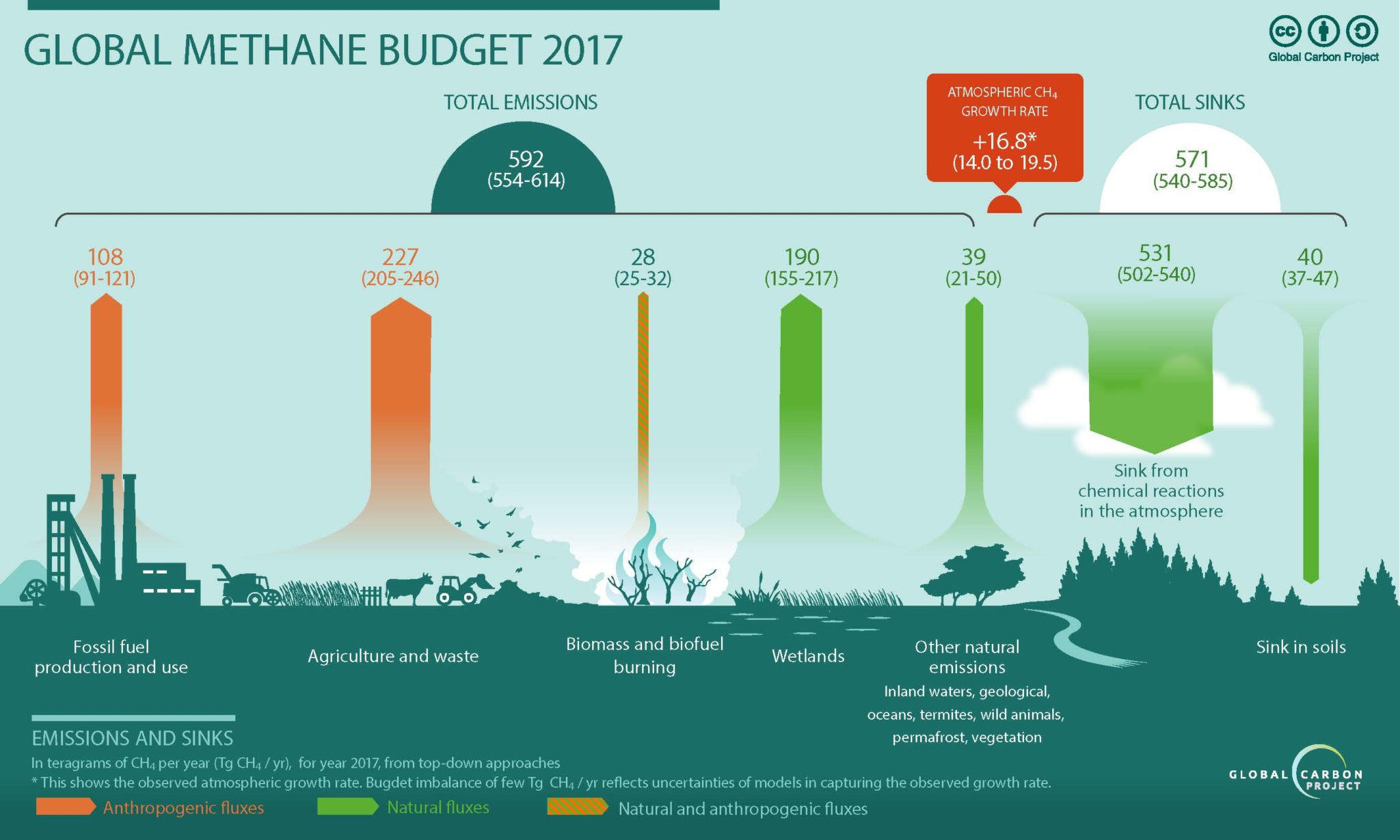
- Methane is emitted from a range of anthropogenic sources like landfills, agriculture, and fossil fuels, as well as natural systems like wetlands.
- It is the second most important greenhouse gas that humans are contributing to.
- Since pre-industrial times, increases in atmospheric methane have contributed to a quarter of the climate-warming effect from greenhouse gases.
- But unlike carbon dioxide, methane has a shorter lifetime in the atmosphere.
- If big changes are brought in our emissions, methane can be removed relatively quickly.
- Recently international team of scientists has published an update on the global methane budget as part of the Global Carbon Project.
- They estimated annual global methane emissions at nearly 570 million tons for the 2008 to 2017 decade which is 5% higher than emissions recorded in the early 2000s.
- It estimated that wetlands made up for the largest natural source of methane and other sources like agriculture, waste and fossil fuels contributed to 60%.
- Wetlands are estimated to make up 20% to 30% of the global methane budget, but emissions vary by latitude.
- The fluxes are larger in the tropics than in the high latitudes and temperate zones.
Global Carbon Project
- The Global Carbon Project (GCP) is an organization seeks to quantify global greenhouse gas emissions and their causes.
- Established in 2001, its projects include global budgets for three dominant greenhouse gases
- Carbon dioxide,
- Methane,
- Nitrous oxide
- GCP’s complementary efforts are in areas of urban, regional, cumulative, and negative emissions.
- The main object of the group has been to fully understand the carbon cycle.
- The project has brought together emissions experts, earth scientists, and economists to tackle the problem of rising concentrations of greenhouse gases.
- It is currently chaired by Rob Jackson of Stanford University.
International Women's trade Centre
- Kerala will set up India's first international women's trade Centre (WTC) at Angamaly.
- This project has been established in collaboration with the United Nations Sustainable Development Goals as a part of Gender Park initiative of the state government.
- This initiative aims to accelerate women entrepreneurship and secure gender parity while providing women with a safe place away from home to start new businesses, set up or expand, and get their products marketed globally.
- WTC will enable women entrepreneurs to
- Participate in international trade,
- Enjoy greater economic benefits
- Enhance their competitiveness to tap market opportunities.
- Reduced dependency on the informal channels to get access to finances and expertise
- Along with WTC, REACH or Resource Enhancement Academy for Career Heights is also aimed at empowering women with the required life-skills to ensure success in life.
India-UN Development Partnership Fund
- It is a dedicated facility within the United Nations Fund for South-South Cooperation established in 2017.
- It is supported and led by the Government of India.
- It is managed by the United Nations Office for South-South Cooperation.
- It is implemented in collaboration with the United Nations system.
- The Fund project portfolio aims to contribute to the efforts of developing countries towards the realization of the 2030 Agenda for Sustainable Development.
- The Fund now encompasses 36 projects, approved in partnership with 9 United Nations agencies in 37 countries.
- It has made significant strides in advancing the national development goals and commitments of the 2030 Agenda by enlisting the global presence and operational capabilities of the United Nations system in the following areas
- Least developed countries (LDCs),
- landlocked developing countries (LLDCs)
- Small Island developing States (SIDS)
- Recently India has contributed $15.46 million to the India-UN Development Partnership Fund, to support developing nations in their developmental priorities across all the Sustainable Development Goals.
- The tranche of $15.46 million includes $6 million to the overall fund, in which all the developing countries are eligible for partnership, and $9.46 million dedicated to the Commonwealth countries.
Human African Trypanosomiasis
- Human African Trypanosomiasis or sleeping sickness, is a disease caused by parasites transmitted through infected tsetse flies.
- According to the WHO, Sleeping sickness is currently found in 36 sub-Saharan African countries.
- If untreated, it can become fatal.
- There are two types of sleeping sickness.
- Trypanosoma brucei gambiense – This occurs due to the parasite found in 24 countries in west and central Africa.
- It caused more than 88% of reported cases of sleeping sickness in 2019, according to updated estimates made available by the WHO.
- Trypanosoma brucei rhodesiense - This parasite found in 13 countries in eastern and southern Africa.
- This type accounted for the remaining 12% of reported cases in 2019.
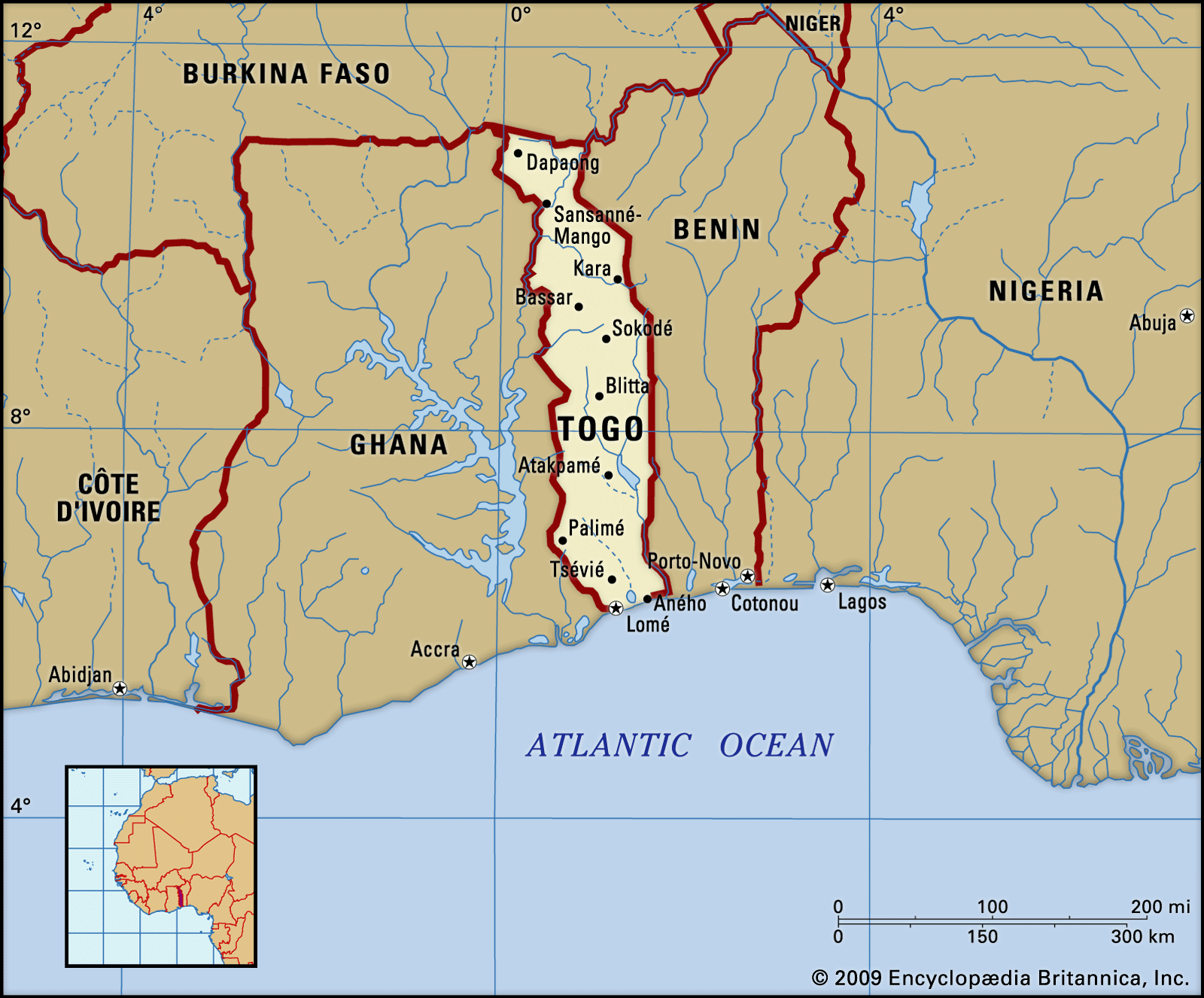
- Recently Togo has become the first country in Africa to eliminate human African Trypanosomiasis.
- Togo is a West African nation on the Gulf of Guinea and it did not report any cases in the past 10 years.
- WHO on August 27, 2020 certified after country applied for it in 2018.
News of the Day : Be Wise Revise
News: Union Minister for Electronics and Information Technology has launched “Chunauti”- Next Generation Startup Challenge Contest to further boost startups and software products with special focus on Tier-II towns of India.
- Chunauti: The programme aims to identify around 300 startups working in identified areas and provide them seed funds of upto Rs. 25 Lakh and other facilities through Software Technology Parks of India centers across India.
- Identified Areas: The Ministry will invite startups in the following areas of work:
- Edu-Tech, Agri-Tech & Fin-Tech Solutions for masses
- Supply Chain, Logistics & Transportation Management
- Infrastructure & Remote monitoring
- Medical Healthcare, Diagnostic, Preventive & Psychological Care
- Jobs & Skilling, Linguistic tools & technologies.
Additional Facts:
- Software Technology Parks of India(STPI): Itis an Autonomous Society set up in 1991 under the Ministry of Electronics and Information Technology (MeitY) to encourage, promote and boost the Software Exports from India.
News: Department of Economic Affairs, Ministry of Finance and United Nations Development Programme(UNDP) India has launched the Sustainable Finance Collaborative(SFC).
Facts:
- Objective: To bring together leading experts and organizations to work together to boost India’s efforts on mobilizing sustainable and green finance.
- The collaborative saw a host of discussions centred around Sustainable Finance architecture in India.It included dialogues on barriers to deploying new and innovative financing such as impact investing, green finance instruments for sustainable development among others.
Additional Facts:
- Sustainable Finance: It refers to any form of financial service integrating environmental, social and governance(ESG) criteria into the business or investment decisions for the lasting benefit of both clients and society at large.
News: The Lakshadweep Administration had embarked on the Pilot project on Biological Control of Rodents(Rats) by Using Barn Owls(Tyto alba) in Kavaratti Island.

- Kavaratti: It is the capital of the Union Territory of Lakshadweep.
- The Kavaratti island is at a distance of 404 km from Kochi,Kerala and is located between Agatti Island on the west and Androth Island on the east.
- Kavaratti has been selected as one of the hundred Indian cities to be developed as a smart city under Prime Minister’s flagship Smart Cities Mission.
Additional Facts:
- Barn Owl: The common barn-owl (Tyto alba) belongs to the family of owls, Tytonidae.It is one of the most widespread owls in Indian Subcontinent.
- IUCN: Listed as ‘least concern’ under IUCN red list.
- Significance: The Barn Owls mostly hunt small mammals especially rodents (hence it’s called as farmer’s friend).
News: A study has suggested that the “Wolbachia method” could be used to significantly reduce the spread of dengue
- Wolbachia: They are safe, natural bacteria present in up to 60% of insect species including some mosquitoes.They are safe for humans, animals and the environment.
- However, it is not usually found in the Aedes aegypti mosquito (responsible for transmitting viruses such as Zika, dengue and chikungunya).
- How does it work? The method involves introducing Wolbachia into populations of Aedes aegypti.When the Wolbachia-infected mosquitoes breed with their wild counterparts, the percentage of mosquitoes carrying the bacterium grows.
- It is not fully understood why the Wolbachia bacterium interferes with the transmission of dengue.One theory is that the bacterium prevents dengue viruses from replicating in mosquito cells.
Additional Facts:
- Dengue: It is a mosquito-borne viral disease widely spread in tropical and subtropical regions.The disease is transmitted by Aedes mosquitoes.
News: Kerala has announced the setting up of India’s first international women’s trade centre(WTC) in consonance with the United Nations sustainable development goals(SDGs).
- Aim: The centre aims to accelerate women entrepreneurship and secure gender parity while providing women with a safe place away from home to start new businesses set up or expand and get their products marketed globally.
Additional Facts:
- Prateeksha: It is Kerala’s first marine ambulance developed by Cochin Shipyard Limited for rescue operations and care of fishermen in distress at sea.
- Women Entrepreneurship Platform(WEP): It is an initiative of NITI Aayog that aims to provide an ecosystem for budding & existing women entrepreneurs across the country by providing different support services like Incubation, training, marketing, mentorship among others.
News: World Urdu Conference 2020 is being organised by the National Council for Promotion of Urdu Language(NCPUL).
- Origin of Urdu Language: The origin of Urdu language had taken place in India several centuries back and historical references indicate that it had taken place in Punjab state of India.
- The poet Ameer Khusro, in his book ‘Ghurrat-ul- Kamal’ had written that Masood Lahori, a poet born in Lahore in the 11th century had composed poetry in Hindvi(Urdu) which is also called Dehlavi.
- How did it develop and flourish? Historians said that it had developed and flourished in Delhi during the period of ‘Delhi Sultanate’ from 12th to 16th century and then during the period of ‘Mughal Empire’ in Delhi from 16th century to 19th century.
- Urdu Official Status in India: It is one of the official languages under the Constitution of India.It is also one of the official languages in states like Kashmir, Telangana, UP, Bihar, New Delhi and West Bengal.
Additional Facts:
- National Council for Promotion of Urdu Language: It is an autonomous body formed in 1996 under the Ministry of Education.It was set up to promote, develop and propagate the Urdu language.
News: Pradhan Mantri Jan-Dhan Yojana (PMJDY) – National Mission for Financial Inclusion has completed six years of successful implementation.
Facts:
- Pradhan Mantri Jan-Dhan Yojana(PMJDY): It was launched in 2014 to ensure universal access to financial services namely, Banking/ Savings & Deposit Accounts, Remittance, Credit, Insurance, Pension in an affordable manner through the use of technology.
- Features: The scheme was launched based upon the following 6 pillars:
- Universal access to banking services – Branch and BC
- Basic savings bank accounts with overdraft(OD) facility of Rs. 10,000/- to every household
- Financial Literacy Program– Promoting savings, use of ATMs, getting ready for credit, availing insurance and pensions, using basic mobile phones for banking
- Creation of Credit Guarantee Fund – To provide banks some guarantee against defaults
- Insurance – Accident cover up to Rs. 1,00,000 and life cover of Rs. 30,000 on account opened between 15 Aug 2014 to 31 January 2015
- Pension scheme for Unorganized sector.
- Extension of PMJDY with New features – The Government has decided to extend the comprehensive PMJDY program beyond 2018 with some modifications:
- Focus shift from ‘Every Household’ to Every Unbanked Adult
- RuPay Card Insurance – Free accidental insurance cover on RuPay cards increased from Rs. 1 lakh to Rs. 2 lakh for PMJDY accounts opened after 28.8.2018.
- Enhancement in overdraft facilities – OD limit doubled from Rs 5,000/- to Rs 10,000/-; OD upto Rs 2,000/- (without conditions).
- Increase in upper age limit for OD from 60 to 65 years.
News: A five-judge Bench of the Supreme Court has held that States can sub-classify Scheduled Castes and Scheduled Tribes in the Central List to provide preferential treatment to the “weakest out of the weak”.
- Background: The judgment came on the constitutional validity of Section 4(5) of the Punjab Scheduled Caste and Backward Classes (Reservation in Services) Act, 2006.The act allowed 50% of the reserved Scheduled Castes seats in the State to be allotted to Balmikis and Mazhabi Sikhs.
- What has the court said? The court held that reservation has created inequalities within the reserved castes itself.There is a caste struggle within the reserved class as the benefits of reservation are being usurped by a few.
- Hence,the State cannot be deprived of the power to take care of the qualitative and quantitative difference between different classes and to take ameliorative measures.
- Significance of the Judgement: This decision is contrary to the five bench 2005 E V Chinnaiah v State of Andhra Pradesh judgement that ruled that only the President has the power to notify the inclusion or exclusion of a caste as a Scheduled Caste, and states cannot tinker with the list.
- What next? Since a Bench of equal strength cannot overrule a previous decision, the court has referred it to a 7-judge Bench.
Additional Facts:
- Note: The Central List of Scheduled Castes and Tribes is notified by the President under Articles 341 and 342 of the Constitution.The consent of the Parliament is required to exclude or include castes in the List.In short, States cannot unilaterally add or pull out castes from the List.
- A caste notified as SC in one state may not be a SC in another state.These vary from state to state to prevent disputes as to whether a particular caste is accorded reservation or not.
- No community has been specified as SC in Arunachal Pradesh and Nagaland, and Andaman & Nicobar Islands and Lakshadweep.
- The Constitution treats all Schedule Castes as a single homogeneous group.
Comments
Post a Comment